
What can the Inventory module of Odoo do for your business?
When we think of inventory management, we often think of stock quantities, receipts, or shipments. However, in Odoo, the Inventory module plays a much more strategic role.
The Inventory module of Odoo operates around three pillars: the warehouses and locations where your products move, the stock movements that track each receipt, delivery, or transfer, and the automation rules that trigger purchases and manufacturing without manual intervention. But in Odoo, this module also plays a much more strategic role.
It is from this module that products, replenishment rules, automations, goods movements, and even part of the financial data related to stock valuation are defined.
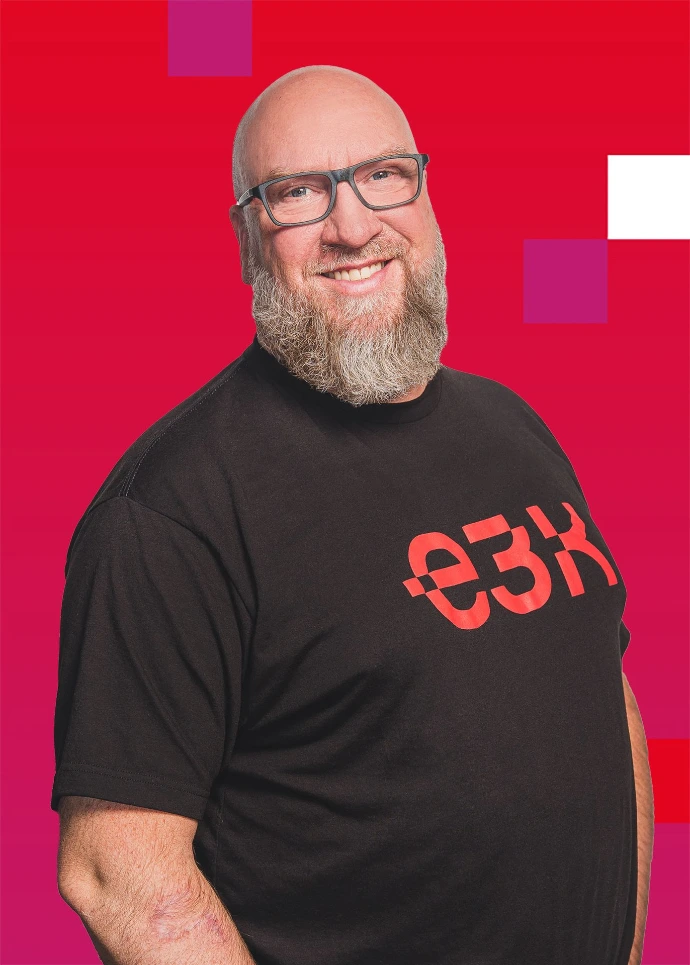
As part of our series "The favorite module of...", Marcel Lachambre explains to us why the Inventory module is, in his opinion, one of the most important in the Odoo ecosystem.
More than a product list: the engine of your operations
"For me, the Inventory module is the heart of an ERP, because everything starts from how you set up your products."
Purchasing, manufacturing, sales, and even accounting rely on the information defined in this module. A good configuration allows the company to fully benefit from the automations offered by Odoo.
What particularly distinguishes Odoo, according to Marcel, is the flexibility offered in product management. Indeed, each product can follow a different path through the organization:
- which departments are involved;
- which operations are triggered;
- which teams are notified;
- which actions need to be executed automatically.
"In Odoo, all of this is configured using routes. And it's surprisingly simple to set up."
This logic allows companies to automate many processes without having to manually manage each step.
How does the Odoo Inventory module actually work?
Basically, everything relies on a simple hierarchy: warehouses, subdivided into locations (receiving area, shelves, preparation area, etc.), and stock movements that circulate products between these locations.
- A warehouse represents a physical location (e.g.: your site in Montreal or Quebec).
- Each warehouse is divided into locations: stock, receiving dock, quality control area, packing area.
- Stock never changes "manually": each variation goes through a tracked operation (receiving, delivery, internal transfer, or inventory adjustment).
In practice, common operations follow this path:
- Receiving : a confirmed purchase generates a receipt; once validated, the products enter stock at the relevant location.
- Delivery : a confirmed sale generates a delivery note; its validation removes stock and tracks the movement.
- Internal transfer : moves products from one location to another (e.g.: warehouse A to warehouse B).
- Inventory adjustment : during a physical count, discrepancies are corrected via a dedicated location (inventory loss), which maintains complete traceability.
This simple mechanism is precisely what enables all the automations that Marcel discusses later: without this well-structured base, no replenishment rule can function correctly.
The tipping point: when you lose control of your inventories
At what point does a company realize that its current tools are no longer sufficient? For Marcel, the signal is often obvious.
"Usually, it's when you start to lose control over the inventories."
The symptoms are generally the same:
- late orders;
- missing products;
- forgotten purchases;
- delayed manufacturing;
- increased manual tracking.
At this stage, processes often rely on Excel sheets, emails, and reminders between colleagues.
The feature that impresses the most: automatic replenishment
If he had to choose a favorite feature, Marcel wouldn't hesitate long.
« The real strength of Odoo is that we should not manage replenishments. We should manage the rules that automate replenishments. »
When products are properly configured, Odoo can automatically :
- identify needs;
- generate required purchases;
- trigger manufacturing orders;
- maintain desired stock levels.
The system then works for the user, rather than the other way around.
Moreover, several companies do not sufficiently exploit the Min-Max replenishment rules, according to Marcel. Yet, the principle is simple :
- a minimum threshold triggers an order;
- a maximum threshold determines the quantity to be maintained in inventory.
For example, if a product has a minimum threshold of 10 units and a maximum threshold of 50, as soon as the virtual stock drops to 9 units, Odoo automatically generates a purchase request (or a manufacturing order) to bring the level back to 50. And since the environment is very flexible, these thresholds can be quickly adjusted as needs evolve.
« You should spend time managing your rules rather than managing your purchases. »
Traceability and multi-warehouse: two often underestimated levers
Beyond replenishment, two features often make the difference :
-
Batch and serial number traceability
Odoo allows tracking each product individually, which becomes essential for companies subject to expiration dates or product recalls. -
Multi-warehouse management
Whether your business has a single site or multiple (factory, central warehouse, point of sale), Odoo allows you to manage each location separately while maintaining a consolidated overview — an asset for growing businesses.
"These are two features that are often activated too late, while they prevent many headaches," Marcel points out.
The most concrete gain: reliable inventories
For Marcel, the first return on investment is often a major improvement in inventory accuracy. By imposing structured processes and centralizing information, the company gains reliability, reduces errors, and improves the quality of its data.
And the most spectacular transformations often occur in companies that managed their stocks using Excel files.
When a sale is confirmed in Odoo, the system can automatically:
- notify the managers;
- initiate the required purchases;
- generate order preparation tasks;
- trigger the next steps in the process.
"When you're in Excel, you spend your time communicating. When you're in an ERP, you track your operations and the system takes care of the rest."
Marcel's advice
To convince his clients, Marcel often asks this simple question:
"Would you rather spend your time understanding why your inventories don't balance or developing your sales?"
His message is clear: the cost of poor inventory management is often much higher than the investment needed to correct the situation. So waiting is rarely a good idea.
Ultimately, Odoo's Inventory module is not just for knowing what is on the shelves. It forms the foundation upon which purchasing, manufacturing, automation, and even some financial data rely.
And it is precisely for this reason that Marcel considers it his favorite module: because when it is well configured, everything else becomes simpler.
No more questions? We answer them.
What is the best inventory management tool?
Where other software requires expensive third-party connectors, Odoo unifies the supply chain within a single environment. Managing product variants, specific storage locations, and order fulfillment is accessible without custom development.
What are the 4 types of inventory?
Odoo supports these different methods through its inventory actions and configurable push rules, allowing each business to adopt the approach that fits its operational reality.
What are the different add-on modules in Odoo?