
Applications here, vacations there, evaluations elsewhere… Does that ring a bell? When tools multiply, so do HR follow-ups.
That’s exactly what I appreciate about the modules Human Resources of Odoo . They do not necessarily replace all specialized HR tools, but they allow for the grouping of several processes in an environment already connected to the rest of the company.
And since operations are in Odoo, why not integrate human resources as well?
Multiple HR functions, one environment
The Odoo Human Resources suite brings together several modules that cover different stages of the employee journey, including
-
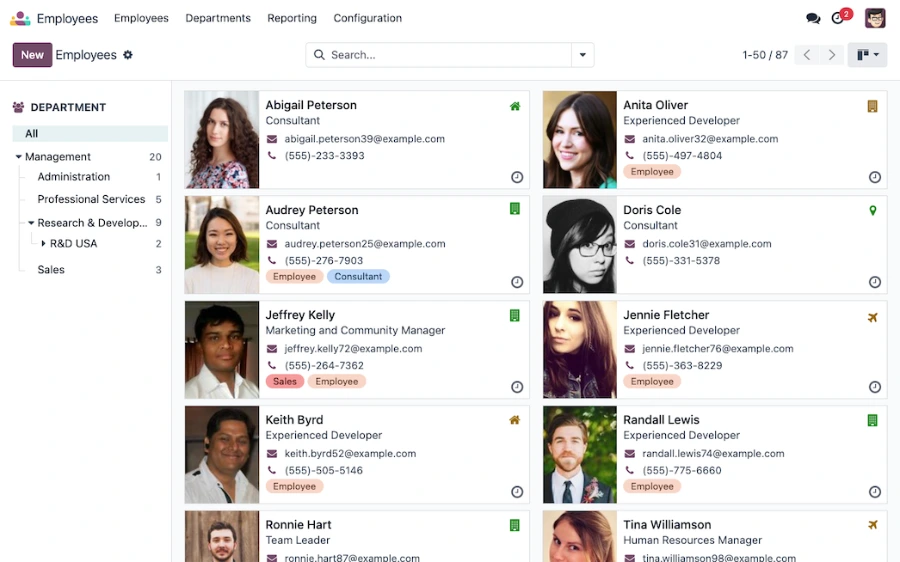
Employees
-
Recruitment
-
Leave
-
Evaluations
-
Recommendations
-
Fleet management.
For me, its great strength is really the interconnection between the different functions. Let’s take recruitment: a company can post its jobs on its website, receive applications, communicate with candidates, and even integrate tests into the hiring process.
Then, when a person is hired, you don’t start from scratch: their file simply continues its journey in Odoo and becomes an employee file.
"It’s really the interconnection that makes the strength of the tool. Information follows the person from one step to the next."

Leave: simple, but particularly effective
If there is one feature that I find particularly useful on a daily basis, it is the management of leave.
Employees can see in real-time what they have left in their vacation or sick leave banks and submit their requests directly in Odoo. Their manager then receives the request for approval.
But what I especially like is that the information does not remain isolated in the HR module. An approved absence can be reflected in planning and timesheets. If a task needs to be assigned to an absent person, the information is therefore visible.
This is a very concrete example of what an integrated ERP can bring: information entered once can be used everywhere it is relevant.
From recruitment to evaluations
You can also use Odoo to structure performance evaluations. The module allows in particular to:
- conduct self-assessments;
- set and track objectives;
- document evaluations;
- manage employee skills.
I would say it is quite simple as a tool, but for an organization that wants to implement an evaluation process without adding another platform, it does the job very well.
The added value of Odoo: its flexibility
Of course, not all organizations manage their human resources in exactly the same way. This is where Odoo's flexibility becomes interesting.
The environment can be adapted to meet certain needs that are not natively covered, for example to carry out follow-ups related to training or workplace accidents.
"For me, the first step is to clearly define your needs. If a function does not exist natively, it can often be automated or even customized."
Does it replace a Quebec HRIS?
Not necessarily, and it's important to specify that.
Odoo being a solution developed internationally, its HR suite does not natively cover all the specifics of Quebec. Quebec payroll, for example, is not integrated, and certain needs like managing group insurance may require other solutions or adaptations.
I would not therefore present Odoo as a direct competitor to the major specialized HRIS here.I see it more as an excellent generalist, particularly for a company that already uses Odoo but does not yet have an integrated HR system.
"It’s probably not for human resources that a company will choose Odoo. But once Odoo is implemented, the HR modules become a nice bonus."
Who do I recommend these modules to?
I find them particularly interesting for organizations that:
- are already using Odoo to manage their operations;
- do not yet have an HRIS;
- wish to further centralize their information;
- want to automate certain HR processes;
- are looking to reduce the number of tools used on a daily basis.
In short, if I had to summarize the main function of Odoo's Human Resources suite in one sentence:
"Spend less time managing HR paperwork and more time taking care of your teams."
My advice: start with your needs

Before thinking about features and automations, I always recommend starting with a simple question: what does your organization actually need?
Once the processes are well defined, we can determine what Odoo can natively support, what can be automated, and, if necessary, what would benefit from customization. Ultimately, the goal is not to add technology for the sake of adding technology. It’s rather to simplify daily life.
Frequently Asked Questions
Here are some frequently asked questions about Odoo's HR modules.
There is no single dominant software everywhere, as the choice depends on the size of the organization and its specific needs. In large companies, solutions like SAP SuccessFactors or Workday remain popular for their robustness. In SMEs, the trend leans more towards integrated tools like Odoo, which combines human resource management, employee tracking, and job posting in a single environment. This all-in-one approach is particularly appealing to teams that want to reduce the number of platforms to manage. What often makes the difference is the ability to automate repetitive administrative tasks rather than the general popularity of a tool. A company that already uses an ERP for its accounting or sales will often benefit from exploring the HR module of the same system before investing elsewhere.
Human resources generally rely on four main areas: personnel administration, recruitment and talent management, training and skills development, as well as labor relations and internal communication. Personnel administration covers employee records, contracts, and attendance tracking. Recruitment encompasses everything from posting job offers to onboarding new hires. Training aims to keep skills up to date, while labor relations involve conflict management and team satisfaction.